
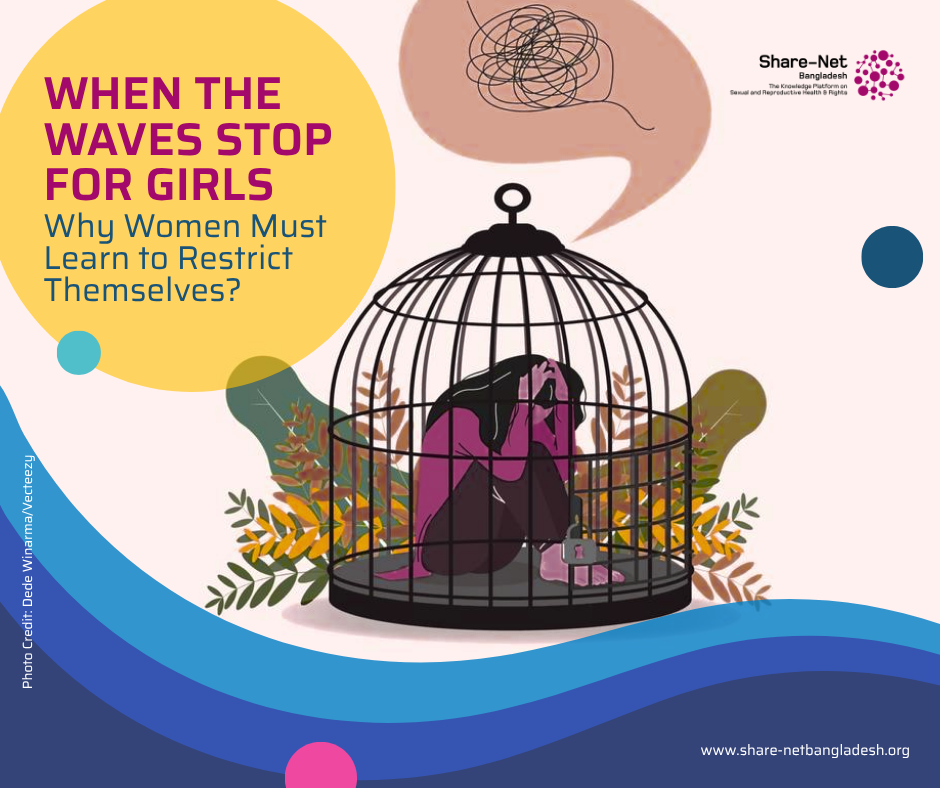
When the Waves Stop for Girls: Why Women Must Learn to Restrict Themselves?
Standing on the shore at Cox’s Bazar, the ocean stretches endless. Children scream with joy as they crash into the waves. Men wade deeper without a second thought. And then the eye settles on the women: most remain where the water grows hesitant, letting only the gentlest foam touch their feet.
They watch. They call out warnings. They anchor the family to the sand. But they rarely allow themselves to float.
As one recent reflection put it, “What happens when the waves soak through their clothes? When wet fabric clings to their bodies… Suddenly, a woman enjoying the sea is no longer simply a woman enjoying the sea.” She becomes someone to be watched, evaluated, whispered about.
This is not just about a day at the beach. It is the visible tip of a much deeper conditioning. Girls and women in Bangladesh learn early to make themselves smaller: to adjust clothing, lower voices, leave early, anticipate discomfort before it arrives. A former science teacher once asked her students a question that still echoes: “Why should I have to make my life harder just because of what men might do?”
The numbers show the cost. Nearly half of Bangladeshi women aged 20–24 (47.2 per cent) were married before 18, according to the Multiple Indicator Cluster Survey 2025. Restricted mobility and constant calculation of “safe space” limit education, delay health-seeking, and shrink decision-making power over their own bodies. The Bangladesh Violence Against Women Survey 2024 found that three out of four women experience intimate partner violence in their lifetime. When public space itself feels conditional, so does bodily autonomy.
Boys face a different set of pressures. While they move more freely through streets, beaches and public transport, rigid expectations of dominance and control still shape many of them. Initiatives promoting positive masculinity, including recent UNFPA programmes, highlight how these same norms harm boys’ emotional wellbeing and increase the risk that they will later perpetuate violence. Freedom for one gender cannot be built on the constraint of the other.
The ache, as the reflection notes, is not that some women choose the shore. Freedom must include the right to remain still. The real question is how many stand there out of preference, and how many are quietly following a lifetime of lessons about what is proper, safe and respectable.
When the ocean itself reminds us how small we are, why do we still insist on making a girl’s world smaller? Real SRHR begins when the right to move, to feel, and to claim space stops being an act of bravery and becomes ordinary.
Source: The Daily Star
Source Contributor: S Arzooman Chowdhury